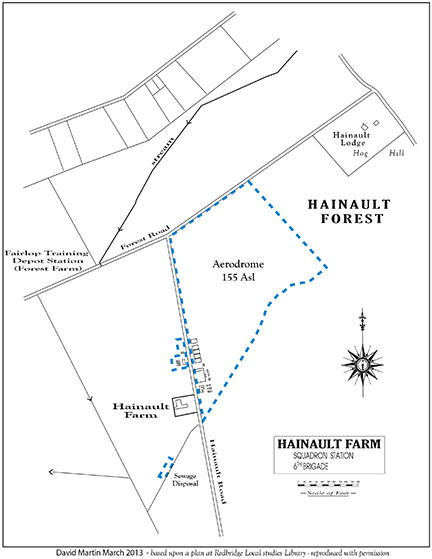
Land by Hainault Farm was originally earmarked by the Admiralty, but became a Day Landing Ground (DLG) in October 1914. It was ultimately used for Home Defence (HD) and in conjunction with North Weald (Epping), Suttons Farm (Hornchurch) and Joyce Green (Dartford), gave cover for the eastern approaches to London and retained that status for the remainder of the war.
The aerodrome had a maximum dimension of 950 x 750 yards, approximately 100 acres and 155 feet above sea level and unlike its near neighbour Fairlop, a rough undulating grass surface, with a subsurface of clay. Consequently it was generally waterlogged in winter.
The station consisted of four large aeroplane sheds, workshops, a technical store, plane, oil and petrol stores and the usual offices: Guard House, ammunition store and a Wireless Telegraphy Hut. The Squadron Offices included an Officers Mess, Officers Quarters, Sergeants Mess, Regimental Stores, Mens Huts and a Coal Yard.
5 Wing HD Detachment.
3 Oct 1915 to Feb 1916.
13/14 October 1915. A force of 5 Naval Zeppelins set off to bomb London – only three reached their target. At 1730 hours the RFC airfields around London received warning of Zeppelin activity.
2/Lt. F.H. Jenkins was airborne from Hainault Farm at 2000 hours in a BE2c (A Royal Aircraft Factory B.E.2 (Blériot Experimental) a single-engine two-seat biplane which was in service with the RFC until the end of the war).
His aircraft took 50 minutes to climb to 10,000 feet by which time the Zeppelins had continued on their way without sighting. The group bombed The City, Croydon and Woolwich, killing 47 and injuring102, and then went on to attack other targets in southern England.
17 Reserve Squadron (RS) HD Detachment.
31 Jan 1916 to 1 Feb 1916.
Squadron was formed in February 1915 at Gosport.
Believed to have been made part of 19 RS HD Squadron.
19 RS HD Detachment.
25 Mar 1916 to 15 April 1916.
19 Squadron was formed from a nucleus provided by No. 5 Reserve Squadron at Castle Bromwich on 1 September 1915. It was almost a year later that the Squadron went to France, flying contact patrols with BE2s before re-equipping with French built SPADS.
39 HD Squadron ‘C’ Flight.
15 April 1916 to 9 December 1916. HQ at Salway Lodge, Woodford Green.
Squadrons were tasked to protect England and particularly London from the threatened Zeppelin and Gotha raids. No. 39 Squadron, formed the core, with personnel from other units.
24/25 August 1916.
Navy Zeppelin L.31 attacks Isle of Dogs, Greenwich, Eltham and Plumstead.
Two BE2s airborne from Hainault Farm. Lt. A.D. Broughton, who flew at 0145 hours quickly became blinded by mist and rain, spun his aircraft into the ground, lucky to escape serious injury, whilst 2/Lt. J.I. Mackay was the only RFC pilot to catch a brief glimpse of L31 that night. Two RNAS pilots from Manston and Eastchurch pursued L31 as it headed for home.
2/3 September. Night Raid. 12 Navy airships, (11 Zeppelins and a Schutte-Lanz) set out to bomb the capital. The whole raid turned out badly as the Zeppelins encountered rain and snow storms over the North Sea and dispersed the airships, from Nottingham and Boston to Norfolk. Severe rain squalls over Hertfordshire, north of London, two Zeppelins were forced to change course and make for home.
A great deal of radio traffic was intercepted, giving warning of a raid, so at 2300 hours. 2/Lt. A. de Bathe Brandon from Hainault Farm covered the line to Suttons Farm.
Kapitanleutnant Alois Bocker on the maiden raid of L.33, crossed the coast at Foulness Island, Essex around 2245 hours, headed towards Billericay then turned towards Brentwood, before dropping incendiary bombs near Upminster. Undetected he dropped a flare south of Chadwell Heath to help determine his position. He continued towards Wanstead and turned away from London, before changing direction again and succeeded in avoiding the AA guns at Beckton. The West Ham gun opened fire as L.33 bombed east London streets.
The Zeppelin flying at 13,000 feet endured a series of near misses from gunfire, which damaged hydrogen gas cells behind the forward engine and other cells midship. This did not prevent more bombs being dropped and L.33 passed over Buckhurst Hill heading towards Chelmsford. In spite of frantic efforts by the crew to repair the shell damage, L.33 began to lose height, and approaching Kelvedon Hatch at 9,000 feet they were picked up by a searchlight as a gun opened fire inflicting more damage.
He succeeded in replacing the gun, but by this time had passed under and past the Zeppelin. He turned and passed along it again, too quickly to take aim. He turned again, came up behind and fitted the drum of ammunition. The Brock ammunition appeared to be bursting all along it, but the Zeppelin did not catch fire. He was using Brock, Pomeroy and Sparklet.
Brock Ammunition. Explosive bullet developed by Commander Frank Brock, (son of Arthur Brock of C.T. Brock, firework manufacturers) designed to explode between the outer casing and gas cells of Zeppelins.
Pomeroy Ammunition. Developed by John Pomeroy from New Zealand – filled with nitro-glycerine, supposed to ignite hydrogen gas.
Sparklet Ammunition. Tracer bullet developed by makers of Sparklet soda siphon.
2/Lt Alfred de Bathe Brandon from New Zealand, flying from Hainault Farm, had been in the air for almost an hour, and had first spotted L.33 as East London was bombed.
He had come close to bringing down L.15 six months earlier, and his bad luck was due to resume this night. As he closed in on the target, his automatic pump failed and he had to work the cocking handle of the Lewis gun, controlling his aircraft at the same time. After loading a drum of ammunition he came up behind the Zeppelin and on raising the gun, jerked it out of the mounting, the gun and yoke fell across The nacelle.
(The nacelle is a housing, separate from the fuselage, that holds equipment on an aircraft).
He turned once again, put on a fresh drum, came up from behind and fired again. The gun jammed after a few rounds. He climbed to get above the Zeppelin, but it became lost in clouds.
His twenty minute attack merely increased the volume of gas escaping through hundreds of bullet holes in the remaining ballonets (an airbag inside the outer envelope of a non-rigid or semi-rigid airship).
The crew aboard L.33 clamboured about the spiders web of alloy girders and bracing wires, surrounding the ballonets, frantically doping and patching, did not yet know how kind fate might be to them.
Front line squadrons were being issued with 97 round Lewis drums to save pilots having to change 47 round drums so frequently. Had Home Defence Squadrons carried double drums, Alfred de Bathe Brandon may have been able to fire 106 rounds instead of 56 rounds.
Determined not to be outdone by a jammed gun, de Bathe Brandon climbed above L.33, intending to use Le Prieur incendiary rockets attached to the outboard struts. As with L.15 the super Zeppelin disappeared into clouds.
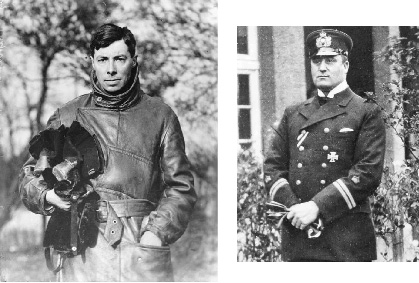
Left: 2/Lt Alfred de Bathe Brandon (John Barfoot)
Right: Kapitanleutnant Alois Bocker (Imperial War Museum)
Losing height fast, L.33 crossed the coast at West Mersea, the crew making every effort to keep her aloft. They began to throw removeable objects overboard, including guns and ammunition. With no hope of being able to get home to occupied Belgium, Kapitanleutnant Alois Bocker ordered the helmsman to turn back. He still hoped that he could find water to sink his crippled ship, but a sudden gust of wind forced him down.
Shortly after 0115 hrs the Zeppelin L.33 landed in a field close to the village of Little Wigborough, halfway between Tiptree and Mersea Island. All 21 crew survived the landing and set fire to the Zeppelin before forming up and marching off down a country lane in a half-hearted attempt to reach the coast.
The crew were arrested shortly afterward by Special Constable Edgar Nicholas.
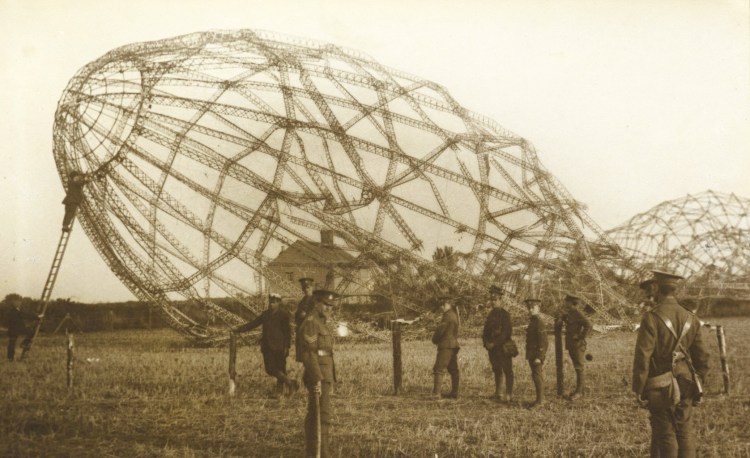
Remains of L.33 at Little Wigborough
The occupants of a cottage, visible through the wreckage, 60 feet away were saved when the crew set L.33 alight because most of the hydrogen had escaped.
(Tollesbury Parish Council).
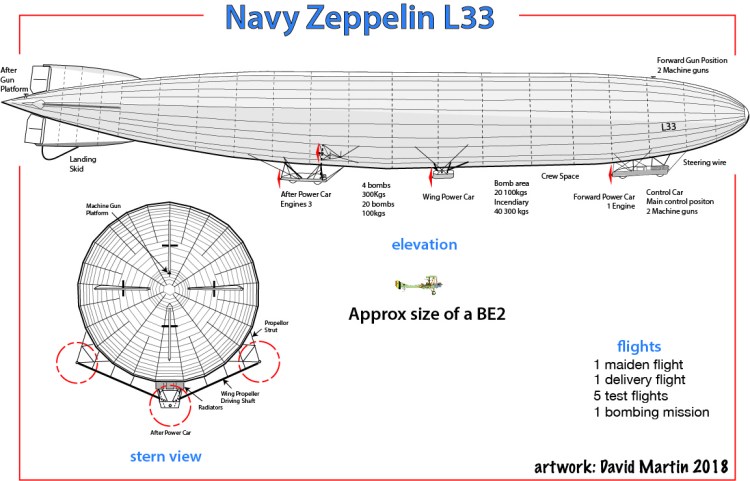
Layout of L33 Navy Zeppelin shot down in 1918
For size comparison : image the nose is in Barkingside High Street by the pedestrian lights close to Fullwell Cross library entrance.
The tail is by Costa Coffee by Hobart Road!
250,000 cases were slaughtered to make gas balloons using intestines
(artwork David Martin)
44 HD Squadron.
24 July 1917 to 1 July 1919.
Personnel included 28 Officers, 19 Warrant Officers and Sergeants, 18 Corporals, 159 rank and file, 12 women and 17 household women, a total complement of 253 souls.
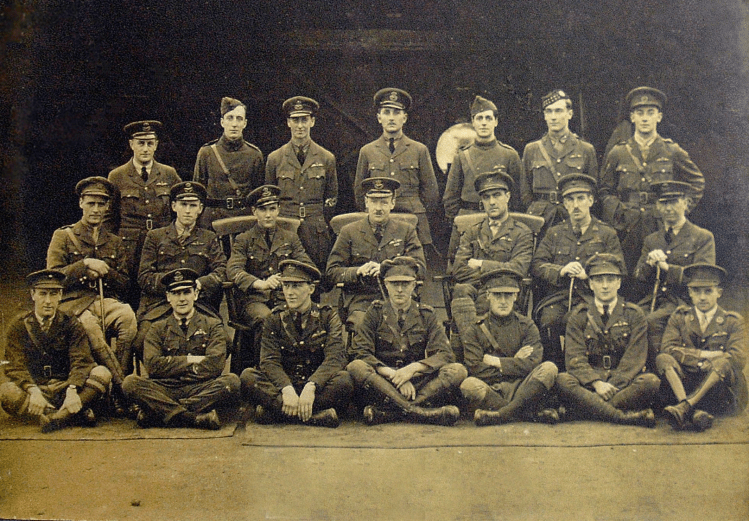
Major Arthur Travers Harris (seated in centre middle row) and Officers of 44 Squadron at Hainault Farm in 1918.
(John Barfoot)
Squadron were equipped with: Machines: 24 Sopwith Camels. Transport: 1 motor car, 7 light tenders, 5 heavy tenders, 6 motorcycles, 4 sidecars, 3 trailers, 2 repair trailers and 1 Ambulance.(44 Squadron. were equipped with the new Sopwith Camel fighter. This fighter was one of the most successful planes flown by any nation in the First World War. 1,294 enemy aircraft were destroyed by Camels from the time of their introduction in the summer of 1917 until the Armistice on 11 November 1918. However, it was difficult to master and no other type scared and killed so many pupil pilots or was so loved and venerated by those who successfully mastered it.
Some camels were converted for night fighter use. They were often referred to as Sopwith ‘Comics’. The guns were mounted above the upper wing centre section each attached to a separate Foster rail-mounting. This permitted the pilot to fire upwards at an angle of 45° or directly forward above the upper wing. The cockpit was relocated back in line with the lower wings trailing edge and the main petrol tank was repositioned in front of the cockpit under the centre wing section. By moving the cockpit back the pilot was given ease of manipulation of the twin Lewis gun mountings. It is recorded that not many Camels were modified.)
24 July 1917. Squadron informed that they were now 44 Squadron, one of three Home Defence Squadrons formed to counter enemy daylight raids.
31 July. Squadron now under overall command of the London Air Defence Area (LADA).
1 August. Atrocious weather conditions in Flanders prevented further Gotha attacks, and the opportunity was taken to bring the newly formed Squadron up to strength. New Sopwith Camels were flown in from No. 3 Aircraft Acceptance Park and were found to be well constructed except for a minor fault with breaking tail skids, resolved by fitting laminated plywood replacements.
There was a requirement for the Squadron to be airborne quickly after receiving an air raid warning. A Klaxon warning hooter wired to a morse key was fitted in the Squadron office was able to alert all officers and men and with practice it became possible to get all available machines airborne in a minute. One improvement was the erection of a ‘Hun’ shaped aeroplane target supported by scaffolding, in a small lake on the north east perimeter of the aerodrome. This provided pilots with a target for air to ground firing practice.
Another innovation was a large white painted revolving set of plywood arrows set around the aerodrome. Visible from up to 17,000 feet, it was possible for pilots to be alerted to the direction anti-aircraft fire directed at enemy raiders, often several miles away.
By this method pilots were able to detect raiders in the direction of the Thames Estuary some 20 miles away, but were held back, fearing there could be a decoy raid. They were kept under strict orders to wait for bombers heading towards the capital. Bombs fell at Rochford aerodrome, also held in reserve in case a second wave of Gothas were to follow, and other towns nearby were targeted before the Gothas droned back out to sea. The dismay at not being allowed to engage the enemy so close was expressed in the officers mess, prompted Major Hubbard to suggest that sun glinting on the wings of the waiting London Defence Squadrons, probably deterred the raiders.
12 August. Daylight raid on Southend, 13 Gothas left Germany, 11 were attacked but none were shot down. 33 civilians were killed, 46 injured and £9,600 damage was incurred. Hainault Farm put 5 Camels into the air led by Captain Mackay in Camel B3827. The other flight members included Captain T. Gran, a Norwegian pilot (flying Camel B3815, Lieutenant E.S. Moulton-Barrett flying Camel B3776 who ran out of fuel and crash landed on his return to Hainault Farm, but was uninjured, Captain G.A.H. Pidcock flying Camel B3883 and Lieutenant G.R. Craig flying Camel B3886. The aeroplane in which Lieutenant Craig was later killed, B3788, also flew that day but in ‘C’ flight being flown by Lt. R.G.H. Adams.
19 August. 1015 hours. 15 Camels off from Hainault Farm as 10 Gothas cross the coast near Margate. The Gothas met a determined barrage of AA fire and attacked by RNAS aircraft from Dover and the attack on London abandoned. 3 Gothas were shot down.
In the evening, the first fatal accident at Hainault Farm. Lt. George Robert Craig MC killed when undertaking fighting practice. As reported on the Accident Certificate, the court of inquiry declared that the plane was wrecked by falling in a spin and that the pilot was instantaneously killed.
Major T.O.B. Hubbard ordered to proceed to 73 Squadron.
24 August. Inquest of Lt. George Robert Craig M.C.
 Fairlop Plain Times