Fairlop was second choice as an aerodrome for use by the Royal Navy Air Service (RNAS) in the Ilford area. Nearby Hainault Farm had been earmarked as a Day Landing Ground in October 1914, handing the site over to the Royal Flying Corps (RFC) in February 1915.
Why Fairlop was not first choice is something of a mystery. Handley Page, (*) a Barking based company used Fairlop as a flying ground from July 1911 until the company moved to Cricklewood a year later.
(*) Handley Page Limited was founded by Frederick Handley page in 1909 as England’s first aircraft manufacturing company. It went into liquidation and ceased to exist in 1970.

Handley Page E/50 (HP5) ‘Yellow Peril’ had its maiden flight from Fairlop in 1911.
Artwork drawn by David Martin

Unlike its nearby counterpart, Hainault Farm, the ground at Fairlop was well drained, an idea spot for an aircraft designer to conduct test flight of his type D Monoplane.
The fact that the two aerodromes were only 400 yards apart, has led to confusion for some people over the passage of time. (Some are also unable to distinguish between Fairlop in WW1 with its WW2 counterpart RAF Station Fairlop, which occupied a much larger site on the other side of Forest Road). In spite of the close proximity there are no recorded incidents of mid air collisions. The collisions that occurred were confined to aircraft from the same aerodrome.
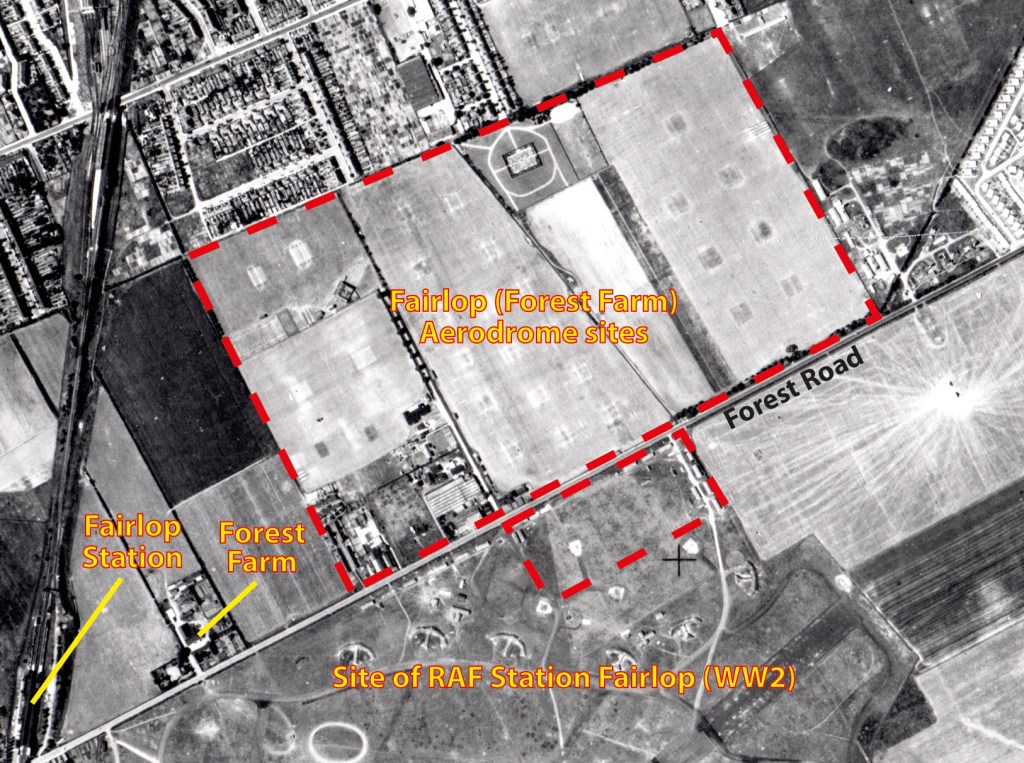
Fairlop (Forest Farm) in 1949. Sites on both sides of Forest Farm
(Aerofilms Limited HAS/IK/49/213 96)
19 July 1916. Accident at Fairlop. Ernest Ashmole, who lived at 1 Thorold Road, Ilford, a civilian carpenter and joiner, suffered serious injuries when a hangar he was assisting to erect, collapsed. Four other men working with him escaped serious injury. Ernest died in the Emergency Hospital Ilford, on 16 August 1916 age 43.
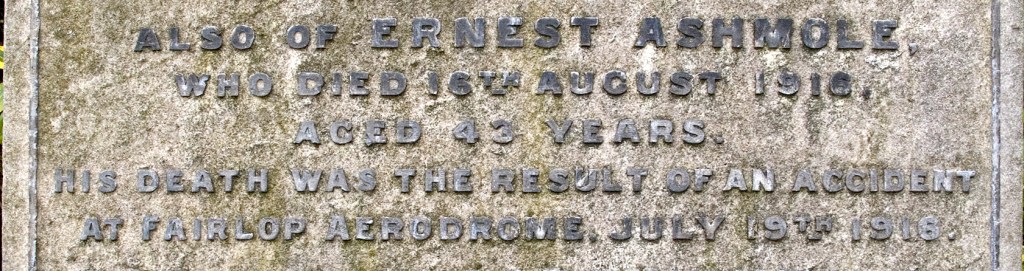
His grave in St Mary the Virgin Churchyard, Ilford, Essex, is not in good condition. He is buried with his parents Henry and Sarah, whose names are not readable. The wording suggests there may have been another child who died before Henry, but the wording is confusing, made worse by missing lead letters.
(David Martin)
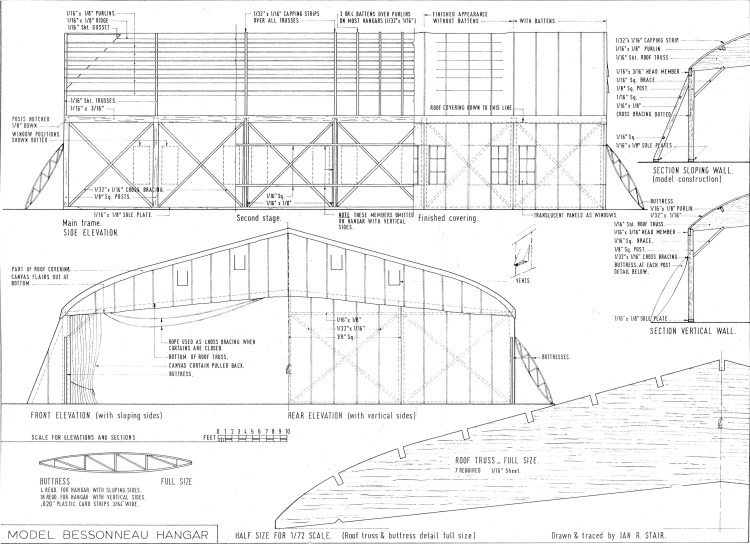
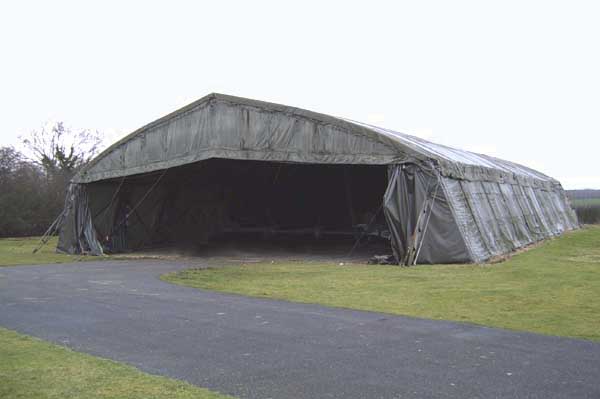
A Bessonneau Hangar was a light timber frame structure covered with canvas. They were made in four sizes of which the 20 x 24 metre type was used by the RFC and the RAF. The size and lightness of the structure made them very liable to storm damage and the canvas doors curtains had to be kept shut as much as possible in windy weather. When shut, heavy cross ropes were used to brace the front. Snow had to be swept off the roof before any weight accumulated. With sloping walls and based on permanent picket anchorages with a concreted floor, their colour was faded mid green with off-white window patches. There were nine Bessonneau Hangars at Fairlop.
21 January 1918. Probationary PiIot Officer William Eric Floyd age 18 from Birkenhead, Merseyside, died when his AVRO 504 burst into flame on landing. William perished in the ball of fire. At the inquest held at IIford Town Hall, F/Lt. Hubert Stanford Broad said he had known the deceased for a month as a pupil under his tuition. The machine was practically new and in perfect condition and he had flown the machine the day before. The deceased left the ground in good style, but at a height of 200 or 300 feet got into difficulties and the machine nose dived to the ground, The petrol tanks burst and the petrol caught alight. There was a huge pool of flame and before the deceased could get out he was dead There was no want of attention on the part of anybody. The jury returned a verdict of accidental death.
William is buried in Birkenhead Fraybrick Cemetery, Birkenhead, Merseyside.
April 1918. Fairlop became No. 207 Training Depot Station (TDS) with Headquarters at Chingford.
7 June 1918. Lt. Francis (Frank) Beacroft Smith MC (*) RNVR attached to RAF, killed at Fairlop age 24 when he walked into a propeller. Frank from Cardonald near Glasgow, is buried in the City of London Cemetery, Manor Park E12.
(*) Awarded Military Cross 17 July 1917. Temporary. Sub-Lt. Francis Beacroft Smith. For conspicuous gallantry during an attack, when leading his men. (at an unnamed location.) Although shot three times, he continued, with great dash and determination to advance, bayoneting three of the enemy and refusing to retire until ordered to do so.
At the inquest a witness 2nd Mechanic Horace Hampshire said he was ordered to start a machine. The deceased was standing near the machine, stepped forward and gave the propeller a swing. He then turned round and stooped as if to pick up something. The propeller struck him and lifted his body clear over the left plane. He died later in hospital.
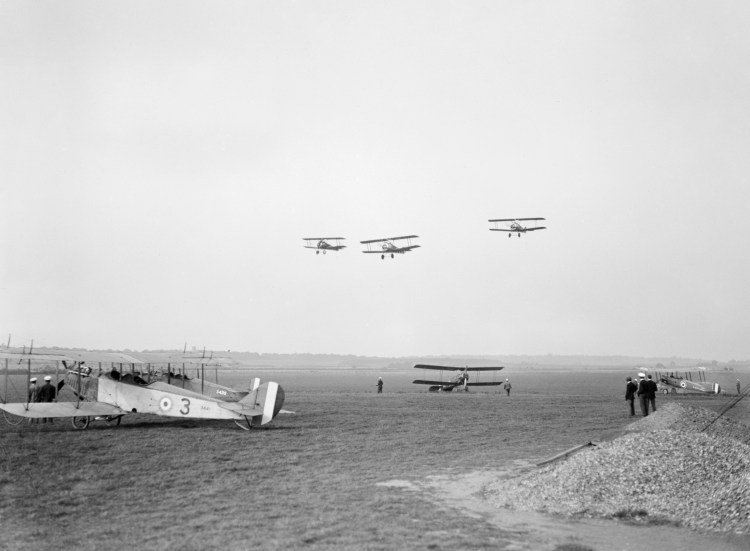
Three Sopwith F1 Camels flying over two Curtiss JN4s (left) and Avro 504Bs (right) at Fairlop (The tower of Chigwell Church can be seen above the 3 of the nearer Curtiss.)
(Imperial War Museum Q 33808)
8 July 1918. Fatal flying accident involving 2/Lt. Charles Homewood R.A.M.C., a pilot of 207 TDS, from Staplehurst, Kent. He was flying solo in AVRO 504K 5843 at about 400 feet, turned his machine to the left without banking, when it stalled and crashed slowly into a field near Forest Road. Captain Hearne who had been driving passing by in his car drove across to the wreck and with the help of airman who had run the short distance from the aerodrome, released the airman trapped under the wreckage. They then drove him in to the sick ward by car.
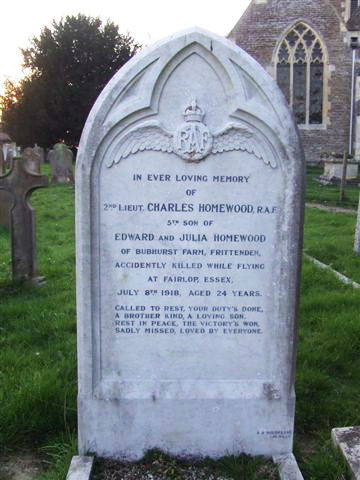
Charles is buried in the churchyard of St Marys Churchyard, Frittenden, Kent.
(Geoffrey Gillon)

25 July 1918. Death of 2/Lt. William Meff. (Service Number not known).
Son of James Meff from Aberdeen, previously mentioned in despatches, he died age 22.
William had reached the last stage of his training before going to France as a qualified pilot. He had just 27 flying hours in his log book.
In the evening he had been airborne for 20 minutes flying Sopwith Camel E1420. He spun into the ground from 500 feet and died from a fractured skull, a victim of the deadly and dangerous Sopwith Camel.
The machine was inspected after the crash and all controls found to be working properly.
27 July 1918. 207 TDS was redesignated 54 TDS at Fairlop to train 2 Fighter Squadron up to front line service standards. Sopwith Camels were allocated to the Depot for advanced pupils.
29 July 1918. F/Sgt. Arnold Bean, a pupil, was in AVRO 504, D7660, piloted by 2/Lt. Harold Hatcher. Their aeroplane collided with a Sopwith Camel F2104 piloted by 2/Lt. Laurie Bell, recently completed flight training at Fairlop.
(Ilford Recorder edition 9 August 1918)
At the inquest held at Ilford Town Hall, the Coroner said the victims were Lt. Harold Blake Hatcher of Bristol, 2/Lt. Laurie Bell of Bournemouth and F/Sgt. Arnold Ralph Bean of Burslem, Stoke on Trent. Lt. Thatcher was an instructor and the other two were pupils. On Monday night at eight o’clock while it was fully daylight, Lt. Hatcher went up in the same machine as 2/Lt. Bell. Surgeon Charles Haines Brown said he was called to the scene of the accident and found that the machines had fallen about 30 feet from each other. Lt. Hatcher was 10 feet away from his wrecked machine and had died of a broken neck. Lying in a sitting position 30 to 40 yards away, F/Sgt. Bean was quite dead. The other victim 2/Lt. Bell was found dead in the debris. All airmen had suffered multiple wounds. Captain Edgar Winter said he was watching the two aeroplanes in the air about 8.30 on Monday evening. He saw one of the machines diving from about 1,200 feet and in the dive it struck the other machine, which was about 30 feet from the ground so that the machine that dived would have immense impetus. Both machines were instantly wrecked and he saw one occupant fall out. Witness said that the top machine fell clean through the lower one and the latter’s wings folded up into a V shape, hovered for a few seconds then fell to the ground. The jury returned a verdict of accidental death and expressed sympathy with the bereaved families and with the brother officers of the deceased.
30 July 1918. 2/Lt. Harry Croyle Curtiss, narrowly escaped death when he crashed into a reservoir at Chingford, undertaking a practice dive on a target. The wheels of his Camel B5659 hit the water and flipped the machine onto its back and sank. He was fortunate to escape serious injury or drowning
2 September 1918. Death of Captain Lorwith Gwilym Davies, age 25, crashed whilst performing acrobatics.
Flying an AVRO 504 D2110, he left the ground in a satisfactory manner and Captain Bailey saw him going through certain evolutions. A few minutes later saw him diving towards the ground and disappeared behind a line of trees about a mile away. He realised that he had met with an accident. Captain Bailey followed the ambulance. Upon arrival there was a faint sign of life but the officer died shortly afterwards. The controls were in perfect order at the time of flying and in his opinion the fatality had occurred through a lack of judgment on the part of the deceased. Accidental death was the verdict returned.
(Ilford Recorder edition 13 September 1918)
Lorwith is buried in Holy Trinity Churchyard, Penton Mewsey, Hampshire.
(Commonwealth War Graves Commission shows his death occurred on 16 March 1918.)
8 October 1918. Flying Cadet Frank Everett flying AVRO D8861, crashed on take off.
Frank, the son of Mr. W.R. Everett from Nunhead, London, is buried in Camberwell Old Cemetery.
6 November 1918. Death of Harry Jassby.
For full details see: Fact Files People
Currently under investigation with the Coroner and Metropolitan Archives
8 January 1919. Death of Flight Sgt. 8/5388 Russell James Cound RAF age 20, the third son of Charles and Mary Anne Cound from Bromsgrove. He is buried in Bromsgrove cemetery, 11 miles north east of Worcester.
Russell was in a new aeroplane, an AVRO D9844, piloted by Lt. R Starbuck. He was taking part in a flight at low level when the machine was caught by the wind and crashed. Russell Cound was killed outright and Lt. Starbuck rendered unconscious.
Russell had previously been employed in the aeroplane department at the Austin Works. Age 18 he joined the Devonshire Regiment and transferred to the air service, then to Denham as a cadet and to Fairlop as a Flight Sergeant, a rank he held for eight months.
Unfortunately for Russell, Fairlop did not send a firing party because of its imminent closure and he does not have a grave marker.
7 February 1919. 54 TDS at Fairlop was disbanded when Fairlop closed.
A Total of 26 Aerodrome building existed on the site, mainly on the southern boundary adjacent to Forest Road.
The usual technical buildings, workshop, oil, petrol and technical stores, 9 Bessoneau Hangars, personnel buildings, Officers Quarters, dining room and men’s huts, baths, latrines and ablutions, were made redundant by the closure.
 Fairlop Plain Times